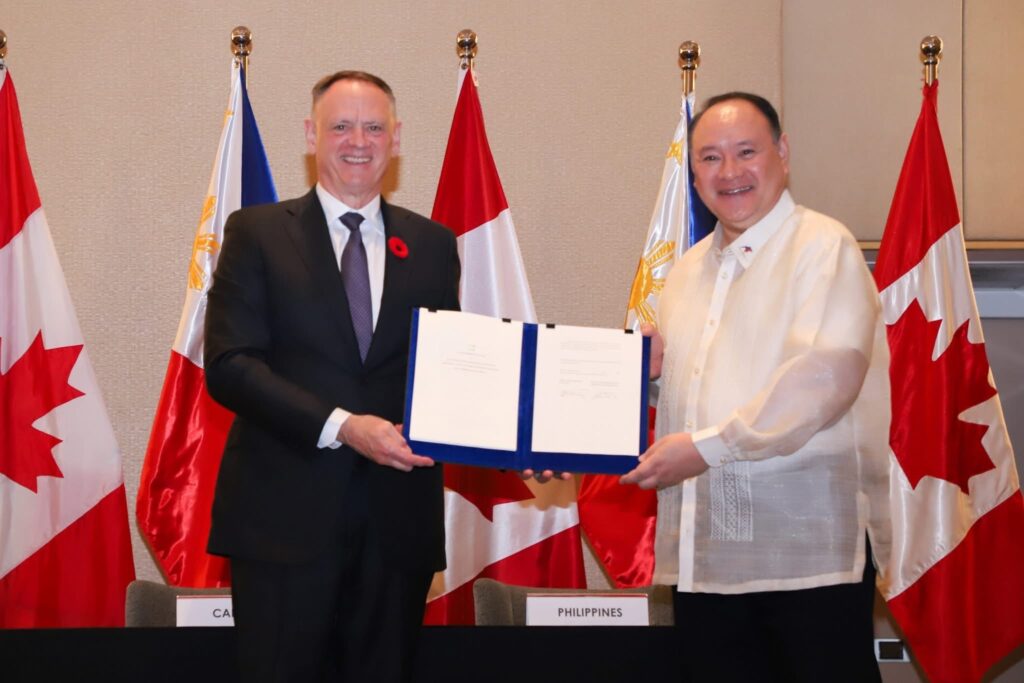
The Philippines and Canada on Sunday signed a Status of Visiting Forces Agreement (SOVFA), marking a milestone in their growing defense partnership.
It is the first such pact for Canada in the Indo-Pacific and fifth for the Philippines, underscoring the nations’ shared commitment to regional stability and the international rules-based order.
Signed by Defense Secretary Gilberto Teodoro Jr. and Canadian Defense Minister David McGuinty after a bilateral meeting in Makati City, the accord establishes a legal framework for expanded military exercises and deeper defense cooperation between the two countries.
“Today is a great day for both of our nations,” McGuinty said in his remarks. “It’s a day that we declare our commitment to deepening our defense cooperation, a commitment to build on the productive and beneficial partnership that we already enjoy—a partnership that stretches back 75 years.”
The agreement, he said, “reflects a deeper truth – that peace is built on rules, not recklessness, and that stability grows from cooperation, not confrontation.”
McGuinty said his Canada’s 2022 Indo-Pacific Strategy paved the way for a more active presence in the region, citing recent naval deployments and participation in exercises such as Exercise Sama-Sama in the Philippines. Canada currently maintains a persistent naval presence of three ships in the Indo-Pacific, spending over 300 days at sea and visiting partner ports – including the Philippines – for more than 80 days in the past year.
“Each visit has strengthened friendships, deepened trust, and enhanced interoperability that keeps our region strong and secure,” McGuinty said.
A milestone for both nations
Teodoro described the signing a “product of true convergence,” crediting the leadership of President Ferdinand Marcos Jr. and Canadian Prime Minister Mark Carney, along with both countries’ defense and foreign affairs departments, for completing the pact “in record time.”
“This agreement converges all these interests into one of the most important projections of trust and confidence between nations,” Teodoro said. “It will allow our armed forces to work together not only bilaterally but also with other like-minded partners to preserve and enforce peace and stability.”
He said the SOVFA reflects both countries’ shared commitment to uphold the rules-based international order, respect sovereignty, and defend human rights and freedoms.
“A state that does not protect the rights of its people has no business claiming that it upholds international law,” Teodoro said. “Canada and the Philippines share common interests from economic development to cybersecurity, disaster response, and resilience – and this agreement provides the framework to deepen that cooperation.”
Senate concurrence required
Teodoro said the SOVFA will still need ratification by the President and concurrence by the Senate before it can take effect. He added that the government will “work on this very quickly.”
When asked how the Canadian agreement differs from Manila’s other VFAs – with the United States, Australia, Japan, and New Zealand – Teodoro said each partnership reflects “distinct specializations and experiences.”
“We have much to learn and much to converge in with Canada, distinct from Australia and the other countries,” he explained. “But we all converge in one area – and that’s upholding international law.”
Shared goals amid regional challenges
McGuinty reaffirmed Canada’s “resolute” support for the Philippines’ sovereignty and territorial integrity, especially amid tensions in the South China Sea.
“The question of moving forward together is exactly why we’re here signing and executing this agreement today,” he said. “Canada has been and remains resolute in support of Filipino sovereignty… This is a big moment for Canada as it moves to sign this new agreement—the first of its kind in the Indo-Pacific.”
He added that Canada hopes to take part in future military exercises, including the Balikatan drills next year, and to expand cooperation in cybersecurity, maritime domain awareness, and emergency management.
Teodoro said the SOVFA symbolizes a “framework of trust” that will strengthen both nations’ ability to predict, prevent, and respond toemerging threats – military or otherwise.
“Together we will be stronger for the greater good of the Indo-Pacific,” he said.
McGuinty shared the view, saying: “Like ships that sail in close company, our nations will move forward together – distinct but aligned and guided by purpose. Today’s signing draws our ships even closer together. We will raise our sails toward a more secure and prosperous future.”
About the Author