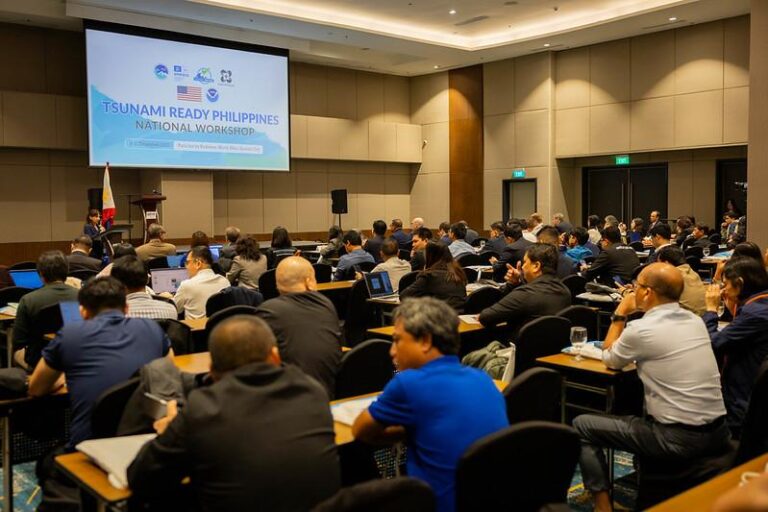
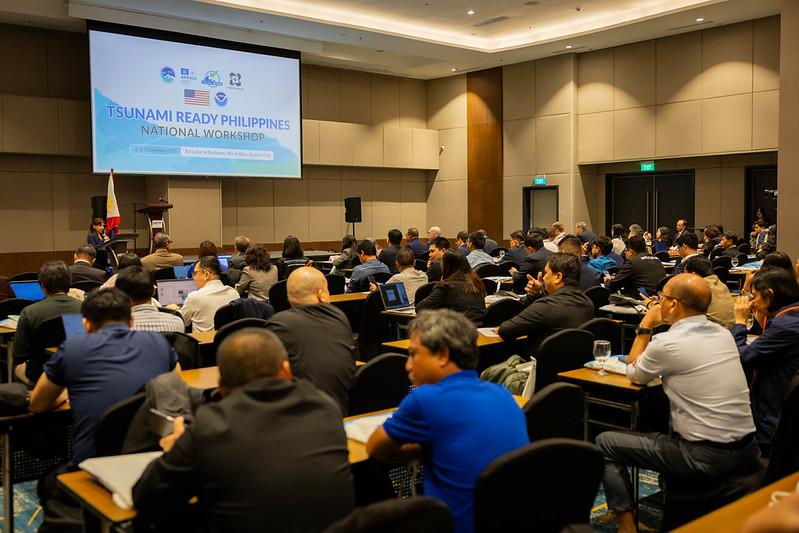
The U.S. National Oceanic and Atmospheric Administration (NOAA) and the Philippines’ Department of Science and Technology–Philippine Institute of Volcanology and Seismology (DOST-Phivolcs)trained more than 140 national and provincial officials and civil society representatives in a three-day workshop on tsunami preparedness and response.
The Tsunami Ready National Workshop, held Dec. 8–11 in Quezon City, brought together experts from NOAA’s International Tsunami Information Center, the Pacific Tsunami Warning Center, and UNESCO’s Intergovernmental Oceanographic Commission. Funded by the U.S. Department of State, the workshop equipped participants to conduct risk assessments and develop effective warning systems and evacuation plans.
“Preparedness saves lives. The Tsunami Ready Workshop demonstrates our two countries’ shared commitment to ensuring every community has the tools to face tsunami threats with confidence,” U.S. Embassy Deputy Chief of Mission Y. Robert Ewing said at the opening ceremony. “For decades, the United States and the Philippines have worked together on disaster preparedness, which keeps Filipinos and visiting Americans safer, stronger, and more prosperous.”
The workshop also supports the Philippines’ implementation of the IOC’s Tsunami Ready Recognition Programme, which sets 12 key indicators for high-risk coastal communities. These include mapping tsunami hazard zones, approving evacuation plans, conducting regular community exercises, and ensuring reliable alert systems. The program was modeled on the U.S. TsunamiReady® program.
“Tsunamis are no-notice events. We don’t know when the next big one will be, so we need to always be ‘Tsunami Ready,’” said Dr. Laura Kong, director of the International Tsunami Information Center, the Pacific’s primary provider of tsunami preparedness training.
DOST Secretary Renato Solidum Jr., in his opening remarks, noted more than 20 years of collaboration with U.S. scientists on tsunami preparedness. “With your help, we hope to finally see our very first internationally recognized Tsunami Ready community—or communities—in the Philippines very soon,” he said.
For decades, the United States and the Philippines have worked together to strengthen disaster resilience. Through agencies like NOAA, the U.S. supports initiatives that help Philippine communities prepare for and respond to natural disasters.
About the Author