Photo courtesy: President Ferdinand Marcos Jr.
The Philippines officially took over the chairmanship of the Association of Southeast Asian Nations (ASEAN) on Tuesday, with the South China Sea issue expected to be high on its agenda.
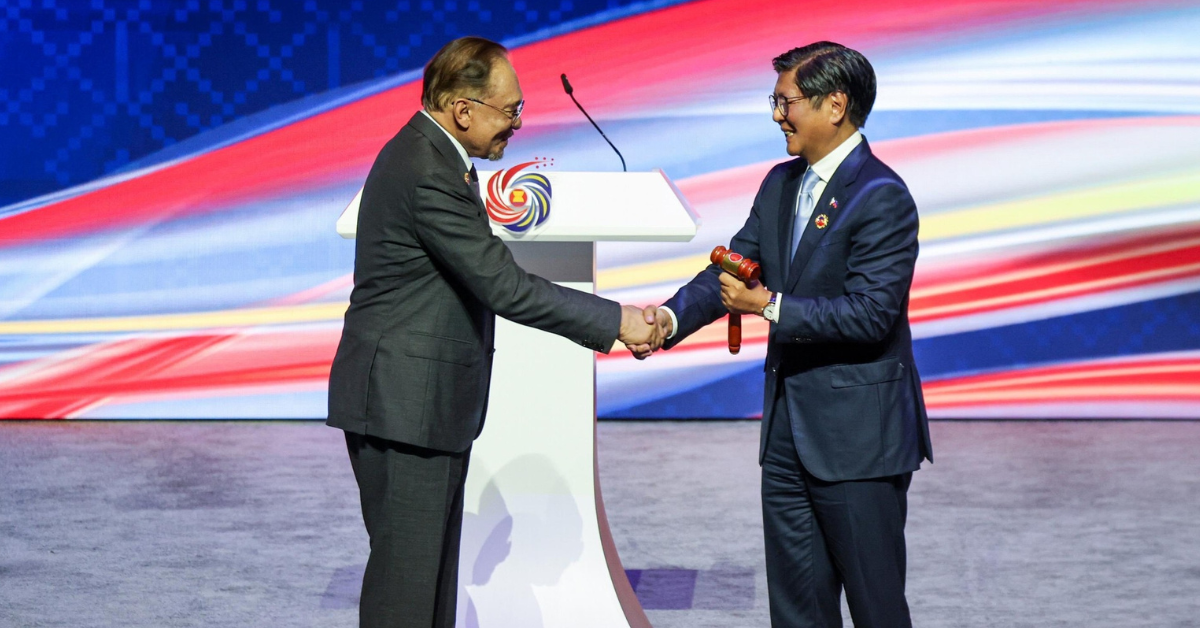
President Ferdinand Marcos Jr. received the ASEAN gavel from Malaysian Prime Minister Anwar Ibrahim in a symbolic handover during the closing ceremony of the 47th ASEAN Summit and Related Summits in Kuala Lumpur, marking the end of Malaysia’s chairmanship over the past year.
“In today’s world where constancy is a rare virtue, Shakespeare warns us against being passion’s slave, and urges us that we would be governed by reason,” Ibrahim said. “ That must be ASEAN’s way if we were to ensure.”
Addressing Marcos, Ibrahim added, “To my friend, Bongbong- good luck! … As you assume this responsibility, i have every confidence that under your steady hand, ASEAN will continue to act with clarity, composure, and that warmth and poise for which Filipino people are known.”
Marcos commended Ibrahim for a “successful ASEAN chairmanship” and for steering the regional bloc “with clarity and conviction,” and reaffirming that the Philippines is ready to lead the bloc.
“Guided by the theme ‘Navigating Our Future, Together’ the Philippines will continue to fortify our peace and security anchors, strengthen our prosperity corridors, and advance people empowerment,” Marcos said.
“Our chairship arrives at the defining moment for ASEAN, one marked by both promise and complexity. Although the tides of change may be unpredictable, our compass must remain constant, anchored in cooperation. It must be oriented toward maintaining a stable and secure region, built upon a shared vision of an open, inclusive, transparent and rules-based ASEAN regional architecture.”
On the sidelines of the annual leaders’ summit, ASEAN and China signed an upgraded free trade agreement to enhance market access in sectors such as agriculture, digital, economy, and pharmaceuticals. East Timor’s accession as ASEAN’s 11th member was also formalized.
As ASEAN chair, the Philippines will have the opportunity to highlight issues of national relevance, said Prof. Renato De Castro, international studies expert at De La Salle University in Manila
“For one year, the Philippine government is given the opportunity to highlight specific issues that are of national relevance,” De Castro said. “At this point in time, the issue that is very close to the heart of the government, our president, and the Filipino nation, is of course China’s aggression and expansion in the West Philippines Sea, South China Sea, and the efforts of the Philippines to highlight, of course, the July 12, 2016 arbitral ruling and the need for a Code of Conduct. (COC).”
ASEAN Member States and China have been negotiating of the COC in the South China Sea since 2018.
UP Political Science Professor and OCTA Research president Ranjit Rye, said the Philippines’ chairmanship of ASEAN in 2026 comes at a a pivotal time time for the region.
“With the theme ‘Navigating Our Future, Together,’ the country is poised to take the helm as ASEAN continues to navigate complex geopolitical currents, including territorial disputes in the South China Sea and evolving major-power rivalries,” Rye said.
“The Philippines’ own direct experience with these issues positions it to steer discussions on regional peace and security with a unique and urgent perspective. Its focus on ‘fortifying our peace and security anchors’ is not just diplomatic rhetoric but a necessary response to the very real challenges that threaten stability and the rule-based order in Southeast Asia,” he added.
Rye said Manila’s prioritiescreflect a comprehensive and forward-looking agenda that’s highly relevant not only for the Filipino people but for the entire ASEAN community.
“By aiming to “strengthen prosperity corridors” and advance “people empowerment,” the chairmanship correctly identifies that lasting security is built upon a foundation of shared economic resilience and inclusive growth,” Rye said.
“This approach ensures that the benefits of regional cooperation extend beyond governments to directly impact the lives of ordinary citizens, fostering a stronger, more connected, and more prosperous ASEAN,” he added.
About the Author