Photo courtesy: Department of National Defense
Signaling a new phase in their defense partnership, the Philippines and the United States have established a joint task force to boost military readiness and deterrence against Chinese aggression in the South China Sea.
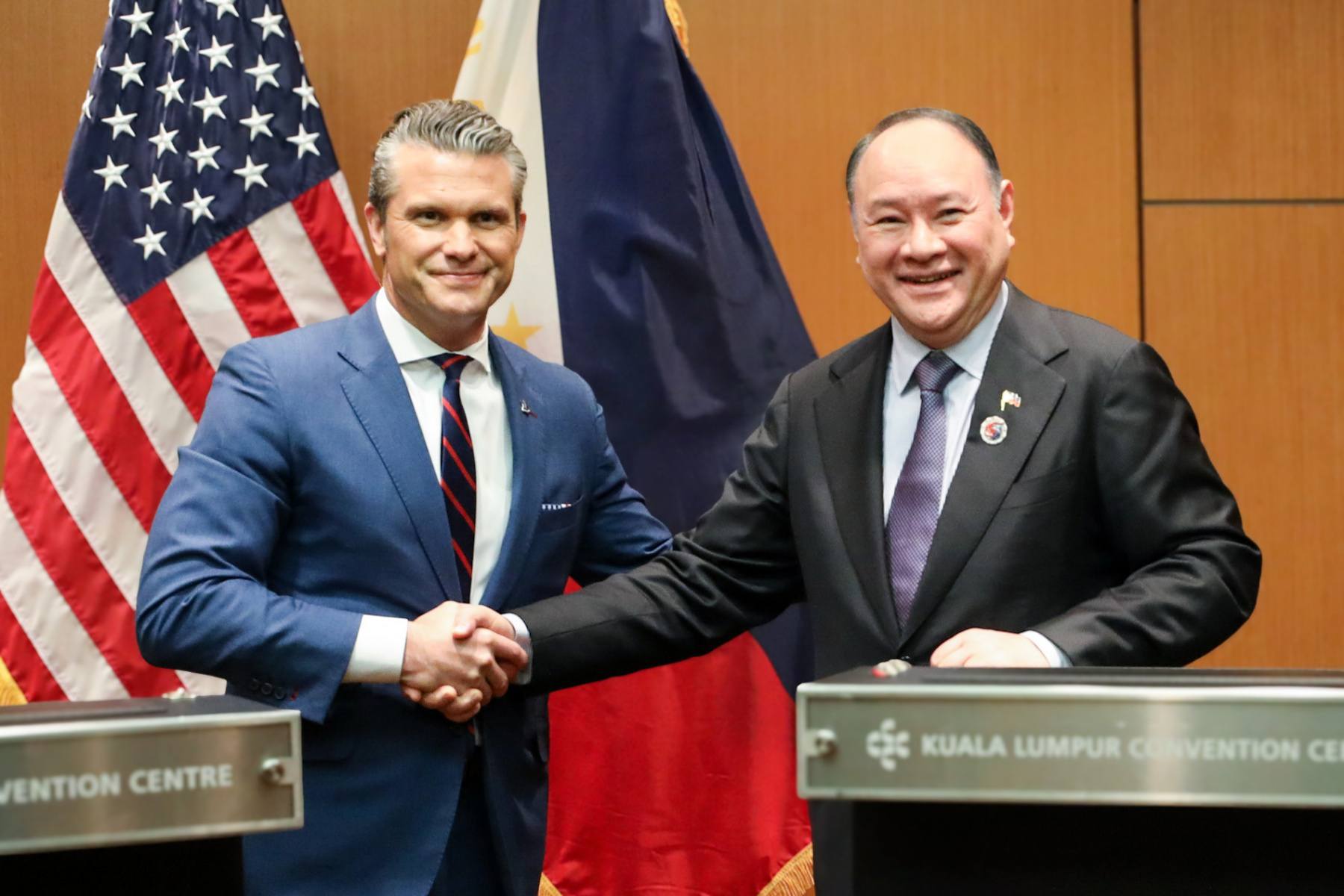
Philippine Defense Secretary Gilberto Teodoro Jr. and U.S. Defense Secretary Pete Hegseth unveiled “Task Force Philippines” on Friday during their meeting on the sidelines of the 2025 ASEAN Defense Ministers’ Meeting (ADMM) and ADMM-Plus in Kuala Lumpur, Malaysia.
“We’re publicly announcing the Task Force Philippines, here with you today, which will be another step in our cooperation, increasing interoperability, exercising and preparedness for contingencies, so that we can decisively respond to crisis or aggression and re-establish deterrence in the South China Sea,” Hegseth said.
He underscored the growing importance of the U.S.-Philippines alliance, calling it a “critically important partnership.”
“Our alliance has never been stronger. Our Mutual Defense Treaty is the bedrock of that,” Hegseth said.
The U.S. defense chief cited China’s coercive actions in the South China, particularly around Scarborough Shoal, where Beijing has reportedly sought establish a nature reserve, as a shared concern for both nations
“It bears repeating that the Mutual Defense Treaty is critical for both countries. Either of our forces anywhere in the South China Sea, it is applicable. And we don’t seek confrontation, but of course, we’re ready to protect our interests individually and mutually.”
Hegseth also announced the completion of an Alliance Readiness Action Plan, which he said will “accelerate all of our major defense priorities.”
Teodoro, for his part, said the establishment of the new task force and the new action plan reflect the extensive work done by both governments to deepen cooperation grounded in shared democratic values and respect for international law.
“The remarks of Secretary Hegseth just put in capsule form the vast amounts of work that both our governments, our leaderships, and our people have put into strengthening the U.S.-Philippine alliance,” Teodoro said.
“The U.S.-Philippine alliance should not be seen in isolation, because the alliance and moving forward now are based on fundamentals. These fundamentals are respect for international law, respect for territorial integrity and sovereignty,” he added.
Teodoro stressed that the alliance is not only important for the two nations but also for maintaining stability and freedom of navigation in the broader Indo-Pacific.
He added that as Hegseth said, it is important that “we interoperate deeper, better, we deter better, we add more allies” because freedom of navigation and respect for sovereignty are not only important for both countries but for the whole world, given the strategic role the Philippines plays in global economic supply chains and the security.
“We look forward to deepening the alliance, not only for now but for future generations of freedom-loving people that both the United States and the Philippines represent,” Teodoro said.
About the Author