Photo courtesy: Department of National Defense
Defense chiefs from Australia, Japan, the Philippines, and the United States reaffirmed their unity in opposing Chinese aggression in the East and South China Seas and backed the creation of an Indo-Pacific defense council to boost regional security.
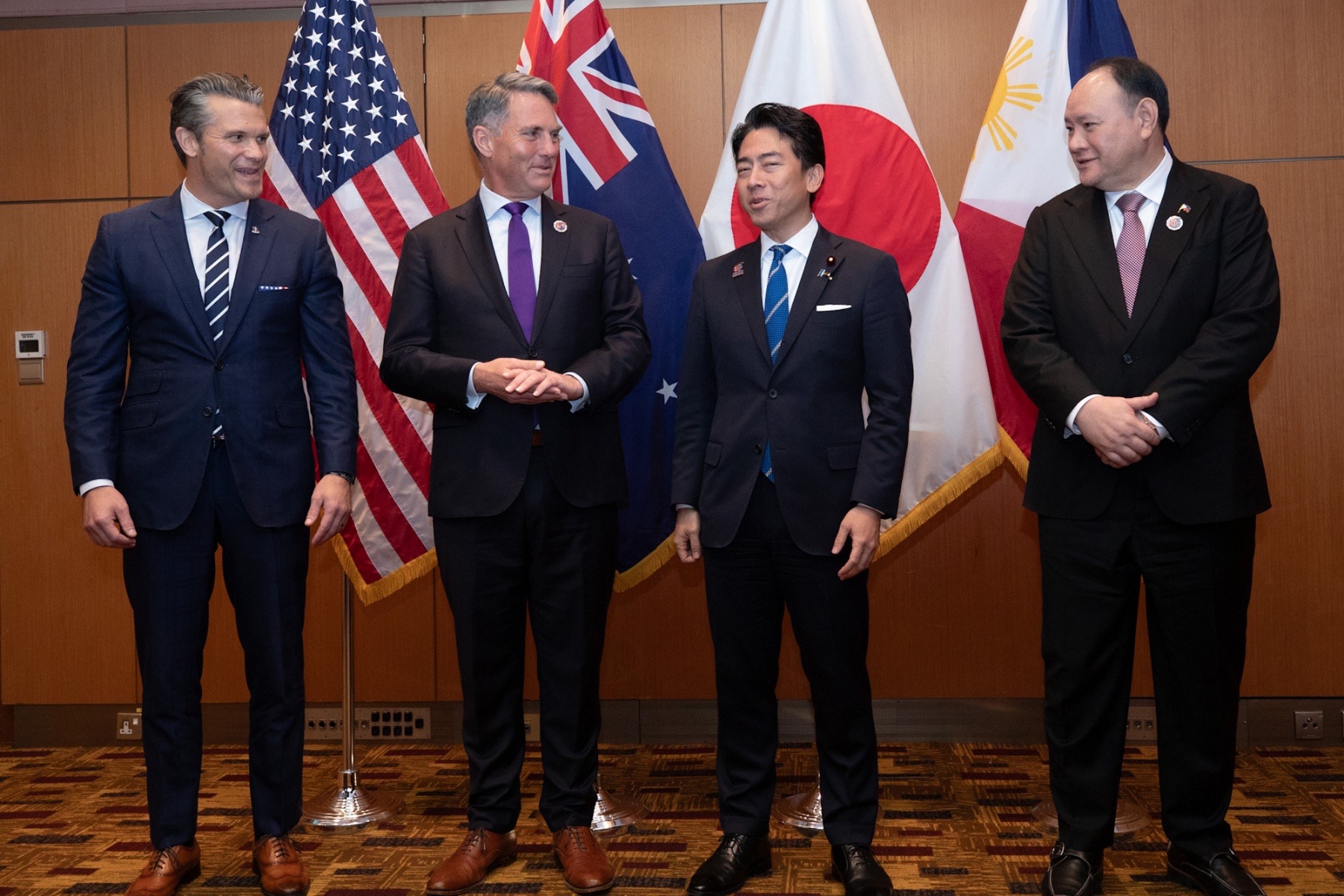
Australian Deputy Prime Minister and Minister for Defence Richard Marles, Japanese Minister of Defense Koizumi Shinjiro, Philippine Secretary of National Defense Gilberto Teodoro Jr., and U.S. Secretary of War Pete Hegseth met on November 1 in Kuala Lumpur, Malaysia. It was the fifth meeting among the four nations’ defense leaders in three years, aimed at advancing their shared vision of a free and open Indo-Pacific.
In a joint statement, the defense chiefs reiterated their “serious concern” over China’s “destabilizing actions” in the East China Sea and the South China Sea, and voiced their strong opposition to any unilateral attempts to change the status quo by force or coercion.
They also underscored the importance of adhering to international law, including the United Nations Convention on the Law of the Sea (UNCLOS), and reaffirmed that the 2016 South China Sea Arbitral Award is final and legally binding.
All four leaders further expressed their continued support for “ASEAN’s central role in shaping the future of the region,” signaling that their growing cooperation is meant to complement, not to compete with, existing regional mechanisms.
The defense chiefs outlined a set of shared commitments to focus their joint efforts on “deterrence and operational readiness” and to “enhance coordinated defense cooperation activities.”
They also discussed progress in information sharing, joint training, and operational coordination to enable advanced operations and seamless coordination among their forces.
“In support of greater alignment between policy and operational objectives, the Ministers and Secretaries expressed support for the framework to establish the Australia, Japan, the Philippines, and the United States Ind0-Pacific Chiefs of Defense Cooperation Council,” the statement said.
Recognizing the importance of interoperability, the defense leaders lauded the entry into force of the Reciprocal Access Agreement between Japan and the Philippines, which allows troops from both nations to operate on each other’s soil, further strengthening bilateral and regional defense readiness.
They also “welcomed the upcoming Balikatan 2026, the next major joint military exercise in the Philippines with participation from all four countries’ armed forces.
About the Author